
Google Pay
Your customer pays with a card saved in Google Wallet, confirmed with a fingerprint, screen lock or device passcode.
On this page9 sections
Google Pay lets your customers pay with a debit or credit card they've already saved to their Google account, confirmed with a fingerprint, their screen lock or their device passcode. There's no card number to type, no CVV to find and no form to fill in, so customers can complete a purchase in just a few taps.
Google Pay is a card payment underneath, so everything on the Card page applies to it too.
At a glance
| Enabled by default | No. Card must be enabled first, then Google Pay is enabled separately. Speak to your account manager |
| Customer needs | A supported device and browser, with a Visa or Mastercard card saved in Google Wallet |
| How the customer approves | Fingerprint, screen lock or device passcode |
| Chargebacks | Yes, the same as card |
| Refunds | Yes, initiated by you from the Ozow Portal. See Refunds |
| Transaction limits | Set by the card issuer. Ozow sets no limit of its own |
| SettlementSettlement Ozow paying the money you have collected into your bank account. Payins arrive at Ozow first and are settled to you on a schedule, so what a customer paid you today and what has been settled to you today are different amounts. | The same as card: typically once a week after the transaction is processed |
institution |
None of its own. Use card's |
How your customer pays
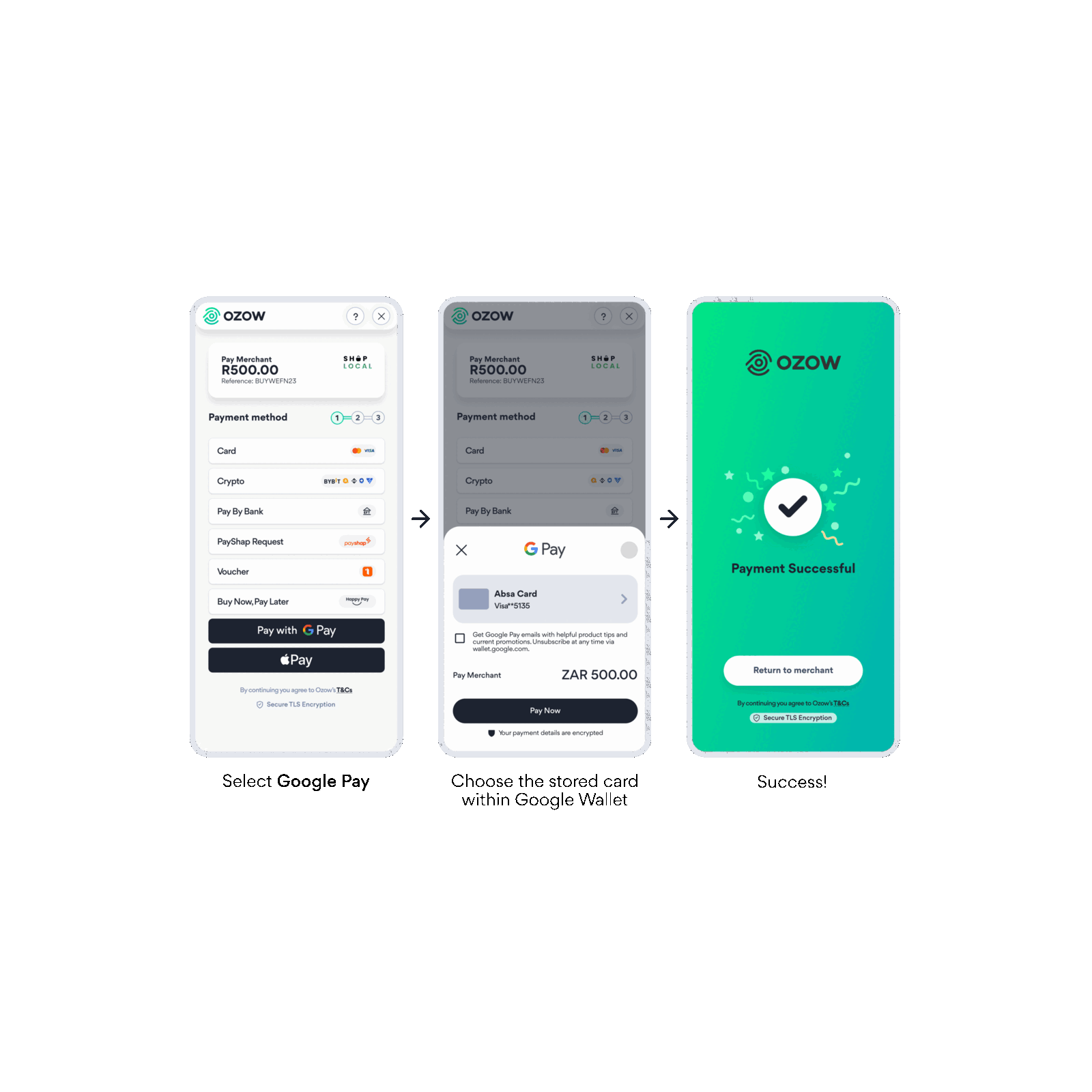
- Your customer selects Google Pay at checkout. The button appears only on supported devices and browsers.
- Google Pay opens and shows the card stored in their Google Wallet. They can change to another saved card if they want.
- They check the amount, tap Pay Now and confirm with a fingerprint, their screen lock or their device passcode.
- Ozow shows a success screen, and your customer taps Return to merchant to go back to your site.
When to use Google Pay
Google Pay suits you if:
- Many of your customers shop on Android devices or in Chrome.
- You want a faster mobile checkout that can improve conversion.
- You want the extra security of tokenised, biometric payments.
Google Pay only appears for customers on supported devices and browsers, so offer it alongside Card and Apple Pay.
Enabling Google Pay
Card has to be enabled first. Google Pay sits on top of card, so you can't have it without card. If card isn't enabled on your account yet, start there. See Card.
Google Pay is then enabled separately. It isn't switched on automatically with card. Speak to your account manager to have it added to your account. You don't need a new acquiring agreement: Google Pay runs on the existing card schemes.
Once both are enabled, the Google Pay button appears on the Ozow payment page for customers whose devices support it. You don't need to change your integration.
Integrating Google Pay
On the Ozow payment page, there's nothing to build. Once card and Google Pay are enabled, the button appears automatically wherever your customers reach the Ozow payment page:
- Hosted Checkout: send your customer to the Ozow payment page using an API-based integration.
- Embedded Checkout: show the Ozow payment page inside your site, as an iframe or a modal.
- No code payment requests
- Plugins and platforms
On your own checkout page, use the Embedded Wallet. It shows Google Pay, Apple Pay and card entry in an iframe on your page. This is a separate build with its own requirements, including content security policyContent Security Policy A response header listing the origins a page is allowed to load scripts, frames and other resources from. A policy that does not name Ozow's origin blocks an embedded checkout, and the browser reports it in the console rather than on the page.MDN allowances. See Embedded Wallet.
Standalone button. There's no separate institutionId for Google Pay. If you're building a
standalone button, use card's. The Google Pay button appears on the card payment screen alongside
card entry. See Standalone payment
buttons.
Button artwork. Google Pay button artwork must come from Google directly, under Google's brand guidelines. Icons for Ozow's other payment methods are in Brand assets.
Confirming payment. Only fulfil an order once you've received a confirmed successful status from Ozow. See Statuses.
Testing
We recommend testing with small live payments in production, using a supported device with a card in Google Wallet. Production payments settle back to you as normal, so it's safe to test this way. If you need staging credentials, contact Ozow support or your account manager.
Refunds, chargebacks, settlement and reconciliation
Google Pay payments work the same way as card payments.
- Refunds: you initiate refunds from the Ozow Portal. See Refunds.
- Chargebacks: a customer can disputeDispute A customer challenging a completed card payment through their own bank. A successful dispute becomes a chargeback and reverses the funds. Distinct from a refund, which you initiate and control. a Google Pay payment through their bank, the same as card. See Card.
- Settlement: typically once a week after the transaction is processed, the same as card. See Settlements.
- Reconciliation: Google Pay transactions settle like standard card payments, typically with a digital wallet indicator in reporting.
Things to know
Google sets its own button rules. How the Google Pay button looks, how big it is and where it sits are governed by Google's published brand guidelines, not by Ozow. Follow Google's guidelines. Ozow can't grant an exception.
There's no per-domain onboarding with Google. Google validates the Ozow iframe origin,
pay.ozow.com, which is already approved. Enabling Google Pay on your Ozow merchant profile is all
the Embedded Wallet needs from you. See Google Pay
setup.
Where the button appears. Google Pay is supported on Android devices and in Chrome.
The Embedded Wallet is a web SDK. It isn't supported inside native iOS or Android apps. For payments in a native app, use Hosted Checkout or a web view.
Card details stay protected. Google Pay uses tokenisation: the real card number is replaced with a secure network token, and each transaction uses a dynamic cryptogram. You never receive raw card details, which reduces your PCI scope, though standard PCI responsibilities still apply.
FAQs
What is a digital wallet? A digital wallet lets customers store card details securely on their device and pay using biometric authentication instead of entering card details manually. Apple Pay and Google Pay are examples.
What are the benefits of accepting Google Pay? Faster checkout, improved conversion, reduced fraud risk, a better mobile experience and secure tokenised payments.
Do I need a new acquiring agreement? No. Google Pay runs on the existing card schemes using your current card setup with Ozow.
How are Google Pay transactions processed? The customer authenticates, Google Pay generates a token, the transaction is sent through the card network, and the authorisation comes back like a standard card payment.
What is tokenisation? Tokenisation replaces the real card number with a secure network token, reducing exposure to sensitive card data.
Is Google Pay PCI compliant? Yes. Google Pay reduces your PCI scope because you don't receive raw card details, though standard PCI responsibilities still apply.
Is Google Pay more secure than card? Yes. It uses biometrics, tokenisation, encryption and a dynamic cryptogram for each transaction.
Will settlement or reconciliation change? No. Google Pay transactions settle like standard card payments, typically with a digital wallet indicator in reporting.
Can Google Pay improve authorisation rates? Often, yes, because the card has been verified when it was added to Google Wallet and there are fewer fraud risk signals.
Which devices support Google Pay? Android devices and Chrome.
Last updated